Marcelo’s eleventh-minute deflection in the 2014 World Cup opener turned a routine Croatian cross into the tournament’s first Brazilian own goal. The stadium went quiet in a way that felt disproportionate to the scoreline. A Brazilian own goal carries a particular charge because it contradicts the national team’s self-image: fluent, forward-minded, rarely reactive. Croatia’s goal did not merely give Brazil a deficit;it forced a favourite to spend seventy minutes repairing a psychological tear. That is the strange power of a Brazilian own goal. It is a statistical event, but it is also a narrative shortcut. The defender’s body becomes the story, and the team’s structure disappears from the replay. For a defender。
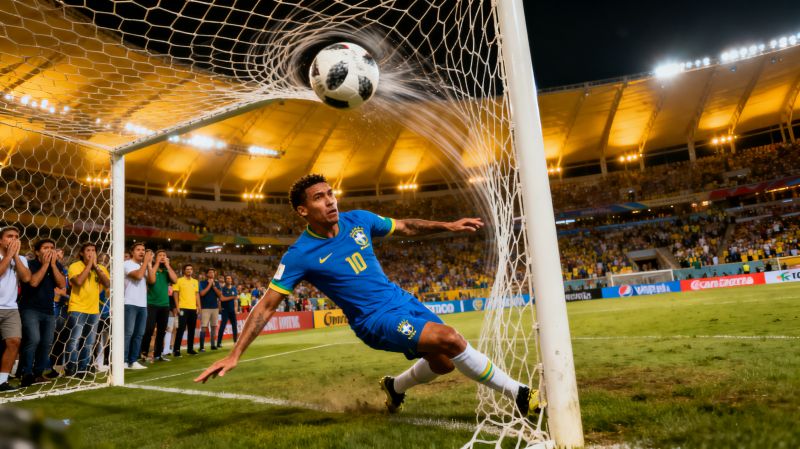
the next touch is the hardest: every clearance invites a second guess, and every sideways pass looks riskier than it did a minute earlier. The own goal did not create the pressure;it made the pressure visible.Four years later, Fernandinho’s deflection against Belgium offered a colder version. A corner flicked off his shoulder and past Alisson;the Brazilian own goal arrived early。and Belgium’s compact block suddenly had the only lead it wanted. Set pieces are where a Brazilian own goal becomes less random than it looks. Brazil’s defenders often mark zonal space rather than a single man, and the first contact can be enough to send the ball across the keeper’s path. When pressure mounts, the margin between a clearing header and a Brazilian own goal is a few centimetres of neck and shoulder. Coaches can drill the shape, but they cannot rehearse the panic that turns a defensive touch into a scoreline change. The Brazilian own goal, in that sense, is a failure of coordination as much as nerve. Brazil’s set-piece marking has improved in cycles, but the national team still occasionally leaves the near-post runner to a midfielder who is watching the ball rather than the man. The near-post chaos is rarely a single mistake;it is a chain of small delays.The media treatment matters. A Brazilian own goal by a midfielder or full-back is often filed under “individual error” yet the sequence usually starts higher up: a loose pass, a slow recovery run, a full-back caught ahead of the ball. Brazil’s attacking tradition makes those gaps acceptable until they are punished. Then the Brazilian own goal becomes evidence in a broader argument about discipline, temperament。
and whether the team is “European enough” tactically. That framing is lazy, but it persists because own goals are visually clean. They give commentators a single moment to blame. A striker’s missed chance invites analysis of movement;a Brazilian own goal invites a verdict on character. The Brazilian own goal is also useful to opponents, who know an early concession can make Brazil chase the game and leave more space behind. That asymmetry explains why a Brazilian own goal can dominate a post-match phone-in even when the midfield was overrun for an hour. Narrative wants a culprit, and an own goal supplies one without requiring tactical literacy.Tactically, the Brazilian own goal is often the price of aggressive geometry. Modern Brazil pushes full-backs high and asks midfielders to cover wide channels;when possession breaks down, centre-backs backpedal toward their own box. A low cross or cut-back creates exactly the kind of chaos where a Brazilian own goal can happen: defender facing his goal, attacker arriving behind him, keeper unsure whether to commit. The 2014 Marcelo moment came from a wide delivery;
Fernandinho’s 2018 touch came from a corner. Different routes。same structural risk. The Brazilian own goal is not proof that Brazilian defenders are uniquely careless. It is proof that a team built to attack must accept awkward transitions, and that tournament football magnifies every awkward touch. A Brazilian own goal can therefore be read as a system cost, not a moral collapse. The same risk appears in club football when Brazilian defenders play in high lines, but the national-team version draws more scrutiny because every match is treated as a referendum. That is why coaches tolerate the risk until a tournament exposes it.What lingers is the human detail. Marcelo did not swing at the ball;he tried to adjust his body and got caught between clearing and shielding. Fernandinho did not duck;he reacted half a second late to a flick he could barely see. Those are ordinary defensive failures。elevated by the label. A Brazilian own goal travels further than a missed penalty because it inverts the expected order: the artist becomes the accidental scorer at the wrong end. Fans remember the deflection, the silence, the replay from behind the goal. The Brazilian own goal, for all the tactical explanation around it, remains a small theatre of hesitation. That is why it sticks. A Brazilian own goal is rarely the whole defeat, but it is the frame through which the defeat gets remembered. The replay loop does the rest: three angles, no context, a defender’s face frozen between apology and disbelief. The numbers record one goal;the memory records a mood.